
#91 Patrick Dunphy
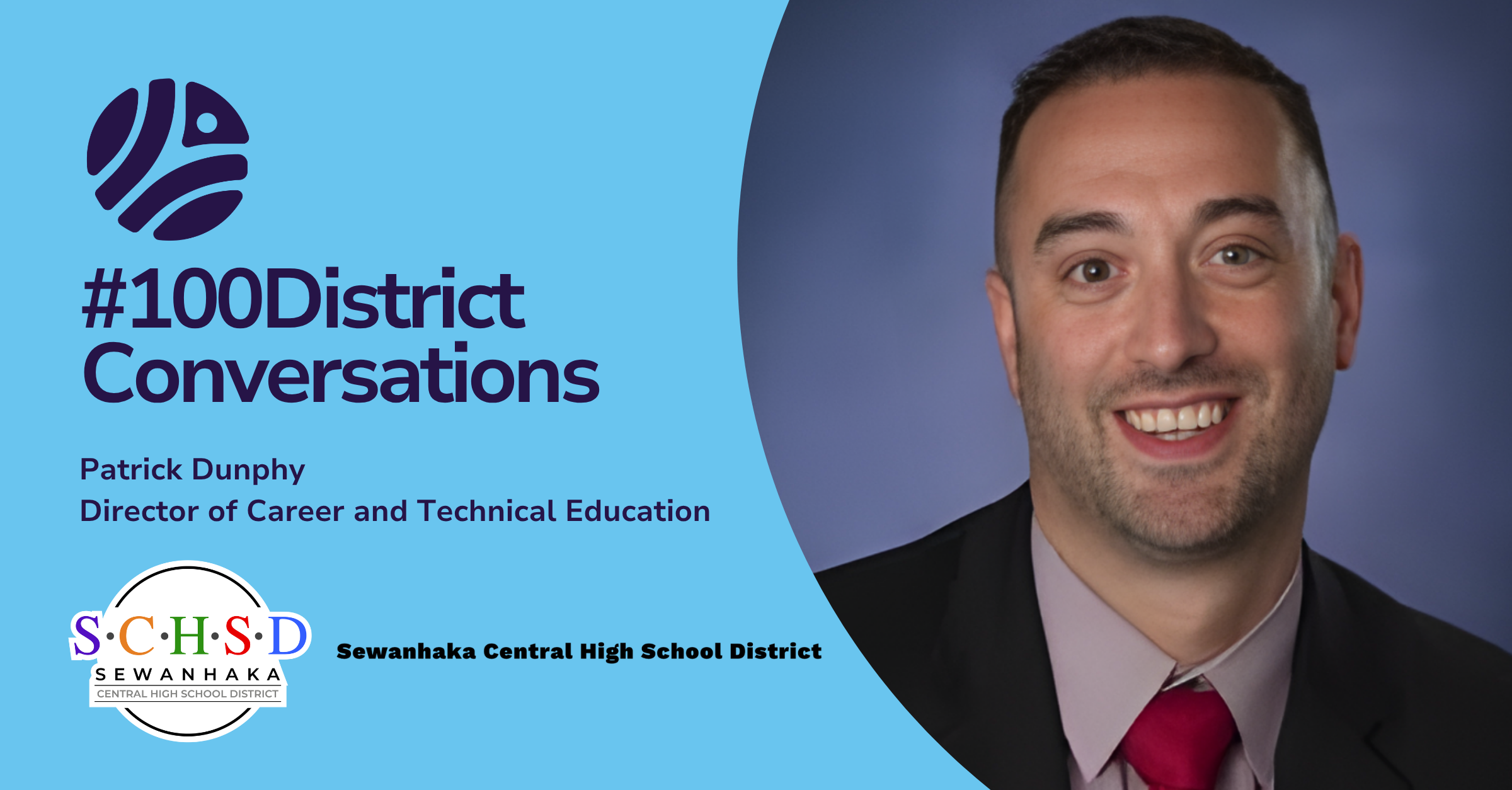
Career and Technical Education (CTE) has been stigmatized for a long time but it's starting to get its due and for good reason! Traditional high school has a lot to learn from the authenticity of CTE programs and career pathway curriculum. I loved getting Patrick Dunphy's perspective as Director of CTE for Sewanhaka Central H.S. District during conversation #91 of 100DistrictConversations. Thank you for the nomination, Michele Leonardo!
"In the field of CTE, many of us are builders and we know meaningful work takes time, patience, and stamina. What keeps me grounded is focusing on what I can control. If I can't get full closure on something, I ask myself: what can I do today to move the needle? Follow-through is everything and I've started to embrace the identity of ‘momentum leader.’
I want to be transformational, not transactional, because I believe every conversation has the potential to positively impact a student's life. I'm reading legislation, making calls, and chasing every lead. Recently I invited a state senator, Siela Bynoe, herself a former CTE student, to visit our district and see our work. I shared a grant proposal, and her openness to the conversation was a reminder that when the foundation has been laid, the relationships have been built, and the follow-through is real, good things can happen.
What makes CTE powerful is that students design for real audiences, not imagined ones. That kind of authentic audience pushes thinking in ways a classroom alone simply cannot. Our students are part of the design process and feel their own sense of urgency. When we explored adding electric vehicle simulators to our automotive program, it was students themselves who identified the need. In architectural design, students move from paper sketches to AutoCAD to SketchUp, designing real classrooms and firehouses and presenting to practicing professionals. Medical assisting students work in pediatric clinics, taking vital signs and reassuring families. Teachers build tier 3 vocabulary and content depth, while our workplace learning coordinators develop durable skills like presentation confidence and professional communication, because the work demands it.
We are fortunate to have a Superintendent who is a true advocate for this work, helping to secure funding, state-of-the-art equipment, and programming, and showing up when students invite her to the table. Approximately 89% of our CTE graduates pursue post-secondary education, and many earn college credits before they even graduate high school.
This is why I push back when I hear people say: 'CTE is great because not every kid is meant to go to college.' That framing undersells what we do. If you go back to the Smith-Hughes Act of 1917, you can trace the artificial divide between vocational and academic education created during WWI. Perkins V is now calling us to bring those worlds back together through co-developed curricula across disciplines, creating authentic work environments that aren’t limited by subject area boundaries."
If you know of a district leader who should be featured in our #100DistrictConversations initiative, please use this nomination form.