
#92 Anna Nolin
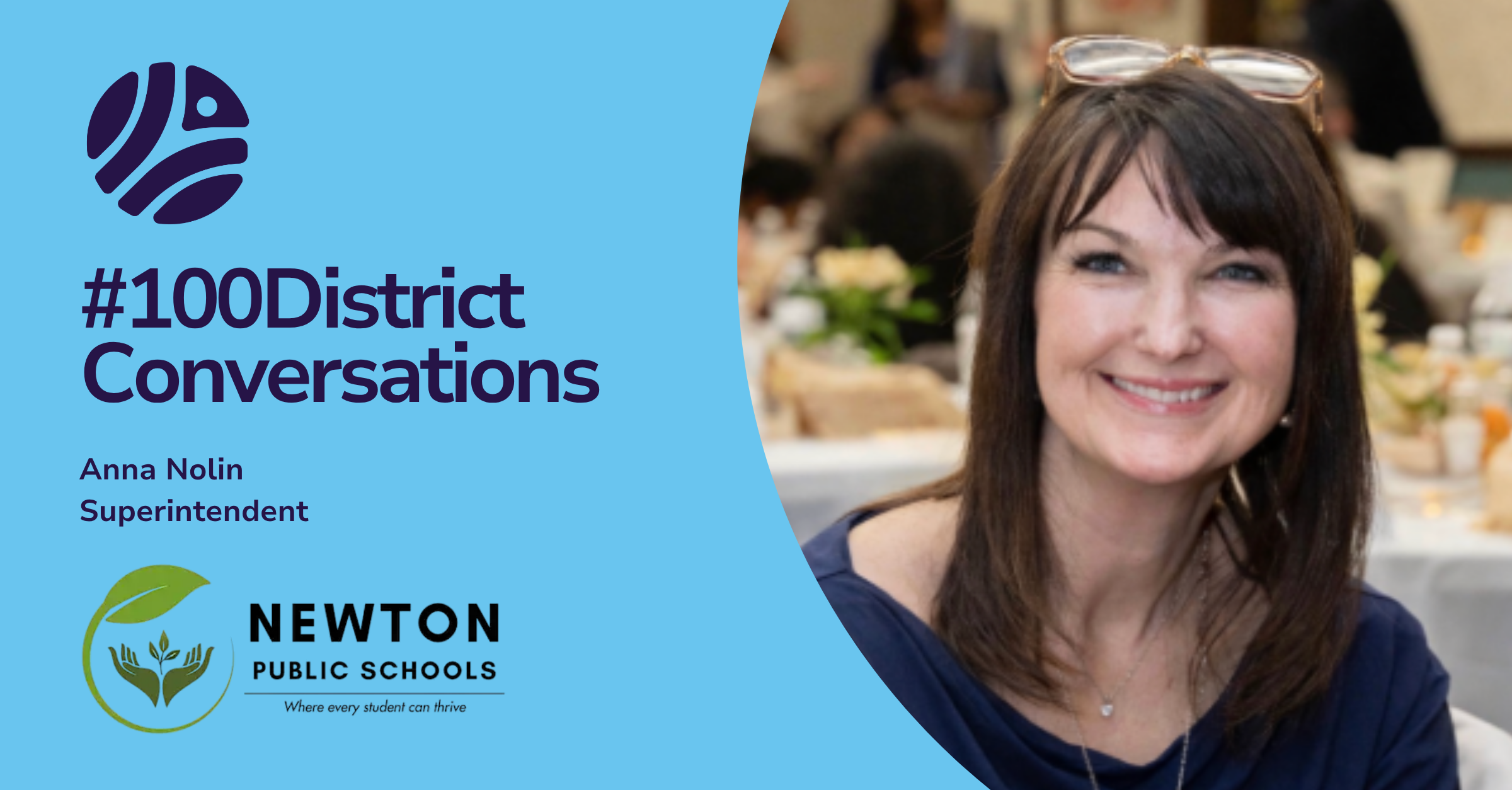
It was a pleasure to sit down in person with Superintendent Anna Nolin at the ASU+GSV Summit last month. We've known and collaborated with Anna for years, from her time in Natick Public Schools to her work now leading Newton Public Schools, a member district in our first PEA²K cohort - a partnership between Throughline Learning and MassCUE.
Anna is someone who holds the long view and the ground-level detail at the same time. In this conversation, she talks about rebuilding professional learning infrastructure from scratch, achieving literacy benchmarks that moved 80-85% of students to, at, or above grade level, and now turning toward AI not as a trend but as a way to restore joy to teaching.
This was conversation #92 of #100DistrictConversations.
"I started my career as a middle school English teacher with zero vision of what professional learning should look like. What I had was my department head and mentor Joan, who brought me into rooms where decisions were made and showed me how to bridge purchased curriculum to the actual needs of the kids in front of you. That mindset of 'Can you follow the learner?' has shaped everything I've done since.
Three years ago I stepped into the superintendency at Newton Public Schools, a district with an extraordinary reputation and strong teaching force. Like many districts post-COVID, we had an opportunity to rebuild our professional learning infrastructure from the ground up with new systems, common curriculum, shared assessments, and job-embedded learning accessible to every educator.
We started with elementary literacy. A parent-driven push toward HQIM led to curriculum adoption that helped (in our most recent literacy assessments) move 80–85% of students to at or above benchmark. We restructured the K-5 school day for CPT and more planning time for elementary educators and we reorganized how specialists and classroom teachers work together. Only 50 Newton students are now reading below grade level in Kindergarten. Proof of concept matters to build trust and sustain momentum. Now, we’re vetting a math HQIM K-12.
We hired a Director of Professional Learning and are building a 5-year onboarding and mentoring cadence for new teachers with updated professional learning areas. We're developing a PLC model built around a 'loose and tight' framework, clear on what we hold in common and what remains flexible/open where teachers have autonomy.
Now AI is the next change management moment. I have set a personal professional practice goal with our school committee to learn how to better use AI, not because it's trendy, but because I believe it can help restore joy to teaching. I want technology to take the administrative weight off teachers so they focus on the type of Socratic coaching our students need: present, connected as humans in a learning system, and generating big ideas.
This year, our high school math leadership and teachers tried out building end-of-unit assessments, working in parallel with an AI tool. The outputs were nearly identical and teachers were pleasantly affirmed and surprised by the assessment design tools. We've also partnered with Renaissance Learning on a sandbox to pilot/shape AI-driven tools in a real district context. It’s rare to see the field being willing to learn with you rather than just sell to you. Research suggests (Damien Bebell, Boston College) that when teachers use technology for genuinely collaborative purposes, both teacher and student satisfaction improve. We're not there yet, but we're building our capacity to work toward this vision."
If you know of a district leader who should be featured in our #100DistrictConversations initiative, please use this nomination form.